
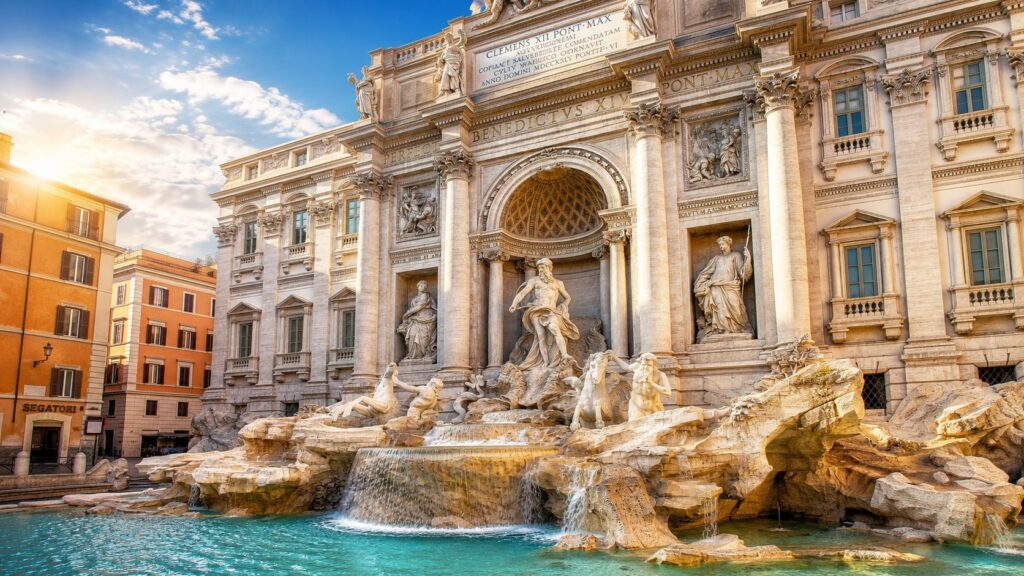
Trevi Fountain Walking Tour: Discover Rome’s Most Famous Fountain
The Trevi Fountain is one of the most famous landmarks in the world. Every year, millions of visitors stop here to admire its beauty, throw a coin into its crystal-clear water, and experience one of Rome’s most iconic places.
Trevi Fountain Walking Tour. More than just a spectacular monument, the Trevi Fountain tells the story of ancient Rome, brilliant engineering, remarkable art, and centuries of tradition.
Every sculpture, every stone, and every stream of water has a meaning waiting to be discovered.
A Trevi Fountain Walking Tour offers much more than a simple visit. It allows you to understand the fascinating history behind one of the greatest masterpieces of the Italian Baroque. With an expert guide, every detail comes to life, transforming a beautiful square into an unforgettable journey through Rome’s past.
Today, the fountain is one of the highlights of many Rome Guided Tours. Its central location also makes it an ideal stop while exploring other historic landmarks such as the Spanish Steps, the Pantheon, and Piazza Navona.
The Ancient Aqua Virgo Aqueduct
The story of the Trevi Fountain begins long before the monument itself was built. It starts with the Aqua Virgo, one of the greatest engineering achievements of Ancient Rome.
The aqueduct was commissioned by Marcus Agrippa in 19 BC during the reign of Emperor Augustus. Its purpose was to supply fresh water to the public baths, gardens, and fountains of the growing city.
Unlike many ancient Roman aqueducts, the Aqua Virgo has never stopped working. For more than two thousand years, it has continued to bring fresh water into the heart of Rome. It remains the only ancient Roman aqueduct that has operated almost continuously since antiquity.
This extraordinary continuity makes the Trevi Fountain much more than a decorative monument. It is the final destination of an engineering system that has survived wars, earthquakes, political changes, and the passing of centuries.
Visitors are often surprised to learn that the water flowing through the fountain still follows the same ancient route established during the Roman Empire. This remarkable connection between the ancient and modern city makes the Trevi Fountain unique.
Why Is It Called the Trevi Fountain?
The name “Trevi” has fascinated historians for centuries.
The most widely accepted explanation comes from the Latin word trivium, meaning “the meeting of three roads.” During the Middle Ages, three important streets converged in the square where the fountain stands today.
Another theory suggests that the name refers to the original fountain, which had three separate water outlets. Although historians continue to discuss the exact origin, both explanations highlight the strong connection between the fountain and the history of the surrounding neighborhood.
Today, Piazza di Trevi remains one of Rome’s busiest and most vibrant squares. Visitors arrive throughout the day to admire the monument, take photographs, and enjoy the unique atmosphere created by the sound of flowing water.
From Ancient Fountain to Baroque Masterpiece
For centuries, a much simpler fountain stood at the end of the Aqua Virgo aqueduct. By the eighteenth century, Pope Clement XII wanted to create a monument worthy of Rome’s artistic prestige.
In 1732, he announced an architectural competition that attracted many of the leading artists of the period. Several impressive projects were submitted, but the winning design came from the Roman architect Nicola Salvi.
Salvi imagined a fountain unlike any other in Europe. Instead of creating a simple decorative structure, he designed a monumental stage where architecture, sculpture, and flowing water would blend into one dramatic composition.
Construction required many years of work. Sadly, Nicola Salvi died before seeing his masterpiece completed. The project was later finished by the architect Giuseppe Pannini in 1762, while remaining faithful to Salvi’s original vision.
The result is the spectacular Trevi Fountain we admire today. It is considered one of the greatest masterpieces of late Baroque art and one of the most photographed monuments in Italy.
Legends and Fascinating Stories of the Trevi Fountain
The Trevi Fountain is much more than one of Rome’s most beautiful monuments. It is a place where history, art, cinema, and local traditions come together. Every day, thousands of visitors admire its impressive Baroque design. Many, however, are unaware of the fascinating stories hidden behind its marble sculptures and flowing water.
The English Romantic poet Percy Bysshe Shelley once wrote that Rome’s fountains alone were worth the journey to the Eternal City. More than two centuries later, his words still ring true. Among all the city’s magnificent fountains, the Trevi Fountain remains the most famous and the most photographed.
During a Trevi Fountain Walking Tour, visitors discover that every corner of the monument tells a story. Some stories are based on history. Others belong to local folklore. Together, they make the fountain one of Rome’s most captivating landmarks.
The Trevi Fountain and the World of Cinema
The Trevi Fountain has appeared in many films. Its most famous role came in Federico Fellini’s masterpiece La Dolce Vita.
In one of the most iconic scenes in cinema history, Anita Ekberg walks into the fountain wearing an elegant black evening gown. She turns to Marcello Mastroianni and invites him with the unforgettable words, “Marcello, come here!”
This scene transformed the Trevi Fountain into an international symbol of romance and Italian cinema. Even today, visitors from around the world come hoping to relive a small part of that magical moment.
The fountain also appeared in the classic Italian comedy Totòtruffa ’62, where the legendary actor Totò pretends to own the monument and tries to sell it to an unsuspecting tourist. The humorous scene has become another memorable chapter in the fountain’s rich cultural history.
The Famous Coin Tradition
No visit to the Trevi Fountain feels complete without throwing a coin into the water.
According to the most popular tradition, visitors should stand with their backs to the fountain and throw the coin over their left shoulder using their right hand.
One coin is said to guarantee a return to Rome.
Two coins are believed to bring new love.
Three coins are traditionally associated with marriage and a happy future together.
Whether people believe the legend or not, the ritual has become one of Rome’s best-loved traditions. Every day, thousands of coins are collected from the fountain and donated to charitable organizations that support people in need.
The Romantic Legend of the Lovers’ Fountain
Few visitors know that a small fountain stands beside the Trevi Fountain. It is known as the Lovers’ Fountain.
According to local tradition, couples who drink from this fountain together will enjoy lasting love and lifelong fidelity.
In the past, this ritual had an even deeper meaning. When young men had to leave Rome for military service or long journeys, their fiancées offered them a glass of water from the fountain.
After drinking, the glass was broken. This symbolic gesture represented loyalty and the hope that the couple would soon be reunited.
Although few people still follow this ancient custom, the story remains one of the most romantic legends connected with the Trevi Fountain.
The Mystery of the “Ace of Cups”
Another curious detail often goes unnoticed.
On one side of the fountain stands a large stone vase known by Romans as the “Ace of Cups.” Its unusual shape resembles the playing card of the same name.
According to local legend, architect Nicola Salvi placed the vase there to block the view of a barber whose shop overlooked the construction site.
The barber constantly criticized the architect’s work and offered unwanted advice. Tired of the interruptions, Salvi supposedly solved the problem by placing the large stone vase directly in front of the barber’s line of sight.
Whether the story is true or simply another Roman legend, it continues to entertain visitors today.
Interesting Facts You May Not Know
The Trevi Fountain continues to surprise even frequent visitors.
Its name most likely comes from the Latin word trivium, meaning the meeting point of three roads. This is where three important streets once converged during the Middle Ages.