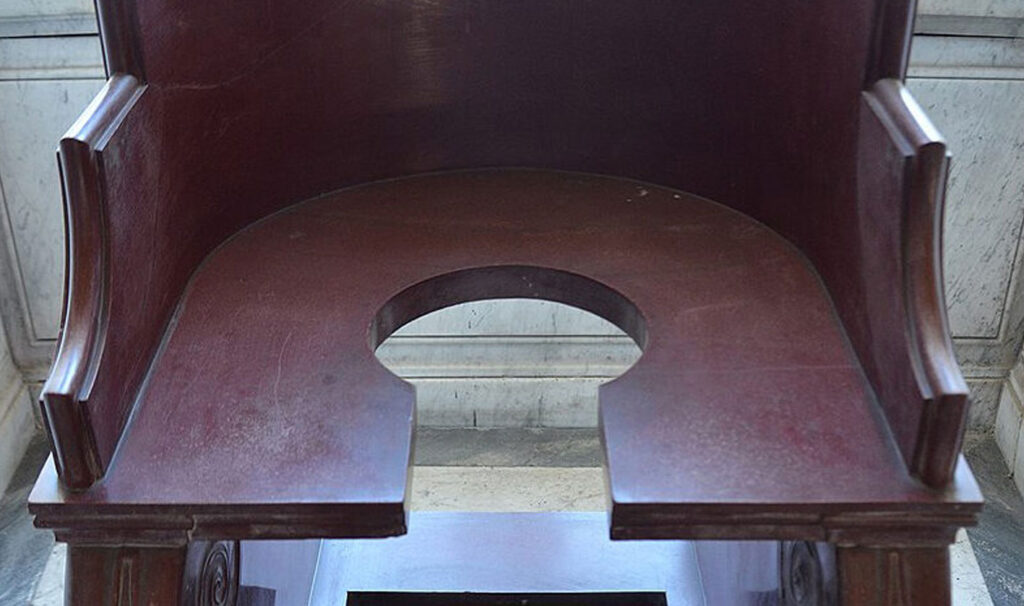
The Sedia Stercoraria: Between Legend and Reality
In the Vatican, more specifically in the Pio Clementino Museum, inside the Room of the Masks, stands one of the most intriguing and fascinating testimonies of Papal Rome: the Sedia Stercoraria.
It is an imperial-era throne made of red porphyry, characterized by a seat with a central opening. The legend of the Sedia Stercoraria originated between the 12th and 13th centuries and was based on the imaginative story of the election of an English woman to the papal throne.
According to the tale, in 853 a figure known as Johannes Anglicus was elected pope under the name John VIII and reigned for about two years, until 855. The so-called popess was allegedly betrayed by her own sexual appetite, which she could not abandon even after ascending the throne of Saint Peter. Having become pregnant, she was returning from the Vatican to the Lateran on Easter Day when her horse, frightened by the surrounding crowd, threw her to the ground. The fall supposedly caused the premature birth of the child, and the baby’s cries revealed her secret. The legend claims that she was then stoned to death and buried near the church of the Four Crowned Saints on the Caelian Hill.
From that moment on, the story continues, every newly elected pope was made to sit on the Sedia Stercoraria in order to prove his masculinity. According to the more colorful versions of the legend, his genitals were examined by young clerics. Once confirmed, they would proclaim aloud: “Virgam et testiculos habet!” (“He has a penis and testicles!”), to which the clergy would respond: “Deo gratias!” (“Thanks be to God!”), before proceeding with the joyful consecration of the new pope.
However, this account does not correspond to historical reality. As entertaining and imaginative as it may be, the story of Pope Joan is a legend, likely developed in anti-papal circles during the period of the Investiture Controversy, possibly within the political climate surrounding Emperor Frederick II.
The use of ceremonial chairs during papal elections is historically documented, but it had nothing to do with verifying the pope’s gender. In the Liber Censuum, written in 1192 by Cencio Savelli (the future Pope Honorius III), the ritual of papal investiture at the Lateran is described in detail. Three chairs are mentioned: one white and two made of red porphyry. Two of them had a hole in the center and were referred to as the “stercoraria” and the “pertusa.”
These were most likely ancient bathing seats, probably reused from the Baths of Caracalla. Such chairs were used after bathing to allow water to drain through the central opening.
According to the described ritual, the newly elected pope would first sit on the throne placed behind the ciborium of Saint John Lateran. He would then be moved to the Sedia Stercoraria and symbolically lifted by his arms and legs, a gesture meant to remind him that God can raise man above filth. Finally, he would proceed to the Chapel of Saint Sylvester, where another porphyry chair, known as the porphyretica, was placed, and there he would receive the insignia of papal authority: the keys of the Basilica, the Lateran Palace, and the papal ferula.
At one stage of the ceremony, the pope assumed a symbolic posture reminiscent of a woman in childbirth, representing the Ecclesia as the generative mother of the Church. This ritual remained in use until 1513 and was suppressed after the election of Pope Leo X.
Of the chairs mentioned, the Sedia Stercoraria is preserved today at Saint John Lateran, while the porphyretica is kept in the Vatican Museums. The white marble chair has been lost, likely destroyed.
The story of the female pope therefore appears to be a burlesque tale, probably of carnival and anti-papal origins. Although repeatedly debunked, it continues to fascinate and entertain visitors to this day.