Narrating Santa Maria in Trastevere in the Time of Innocent II
Among the medieval basilicas of Rome, Santa Maria in Trastevere is certainly one of the most renowned.
Founded in the mid-4th century by Pope Julius I, the church was rebuilt in the 12th century and later restored and enlarged in the following centuries.
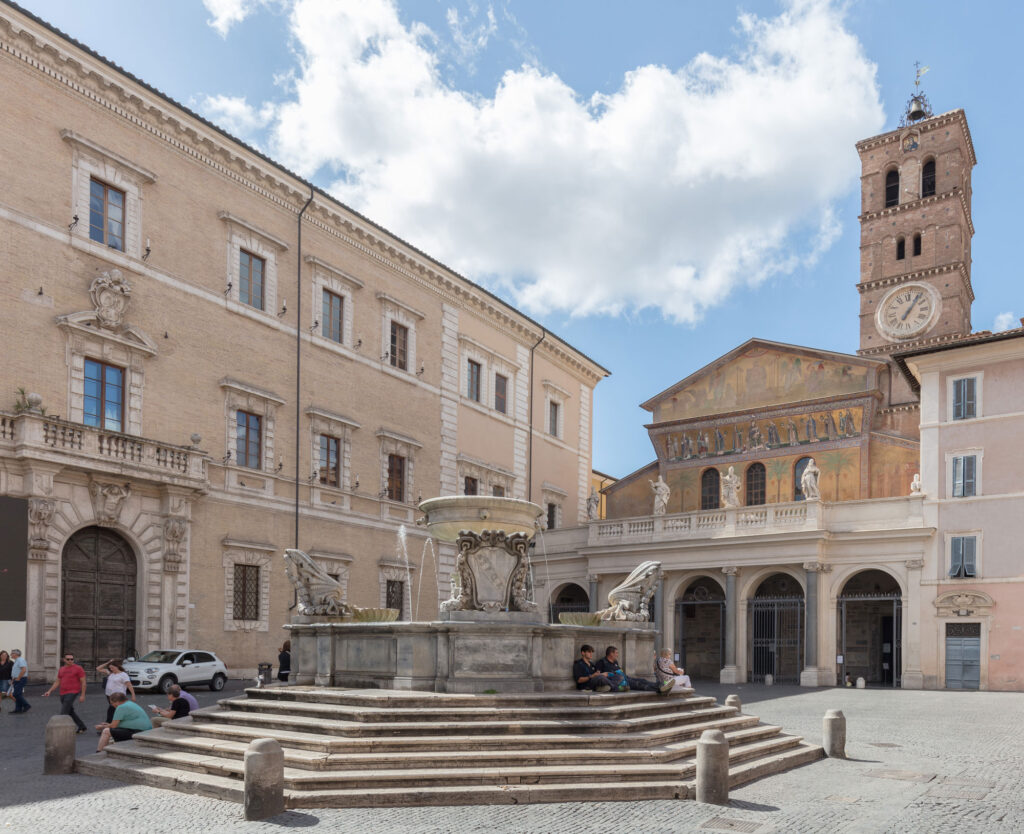
The building welcomes us onto the square of the same name with a 12th-century mosaic frieze depicting the Parable of the Ten Virgins (Matthew 25:1–13).
At the center of the composition stands the Theotokos (the Madonna and Child), flanked by the Wise Virgins who, with their lamps, gather around her as obedient and faithful handmaids of Christ. If you observe this representation carefully, you will notice that not all the lamps are lit—not due to negligence on the part of the medieval artist, but because of an imprudent modern restoration.
The Parable refers to the legend of the foundation of the basilica above the Fons Olei, a spring from which, in 30 BC, oil miraculously began to flow, foretelling the imminent coming of Christ as the Anointed of the Lord.
In the foreground, above the portico designed by Carlo Fontana and before the mosaic of the Virgins, stand the statues of the saints connected with the foundation of the basilica: Saint Callixtus, Saint Calepodius, Saint Cornelius, and Saint Julius.
After crossing the portico—lined with inscriptions from nearby Christian catacombs and with plutei from the early Christian phase of the church—we enter the building and are captivated by the harmony, classical proportions, and decoration of the beautiful basilical nave.
The reused columns from the Baths of Caracalla divide the space according to classical canons, so that the central nave is twice the width of the side aisles. The structure is predominantly medieval, and among the works of this period, the apse mosaic commissioned by Innocent II in 1138 stands out in all its splendor, crowning the newly completed basilica.
At the center of the composition is Christ enthroned, and beside Him the Virgin Queen, crowned with imperial gems and pendilia.
At the sides of the central pair stand the saints—Peter, Lawrence, Calepodius, Callixtus—and Innocent II himself, depicted holding the model of the church and bearing the square halo of the living.
In the central theme, Christ holds a book inscribed with the words: “Come, my chosen one, and I will place you upon my throne.” The Virgin responds: “Light upon my head is the crown, and His right hand embraces me.” This is an Assumption scene accompanied by words from the Song of Songs, the biblical poem whose verses appear on the scrolls held by the central couple.
In this composition, the Queen as Bride of Christ represents the Church, as also described in numerous medieval texts.
The representation is remarkable not only for its style and richness of materials, but especially for its subject, unusual in the Roman context. To understand its importance, the iconography must be placed within the context of the schism of 1130, which saw Innocent II and the antipope Anacletus II engaged in a fierce struggle.
Driven out by the opposing faction led by the Pierleoni, supporters of Anacletus II, Pope Innocent II first went to Germany and then to France to seek allies against his rival. Among them, Saint Bernard of Clairvaux played an important role. Following Innocent II, he came from his mother abbey in southern France to Rome to advocate his cause. It was likely the founder of the Cistercian Order who suggested to Innocent II the theme to be depicted in the apse of the Trastevere basilica. This iconography was particularly widespread in Northern Europe and especially on the portals of French cathedrals.
The Assumption in the apse of Santa Maria in Trastevere exalts the marriage between Christ and His Church—vilified by Anacletus II and once again triumphant with the return of Innocent II.
Another important aspect is the location where Innocent chose to build the basilica celebrating his victory over the schismatic pope.
Constructing the church in Trastevere—where the Pierleoni family, supporters of Anacletus II, owned numerous properties—was a deliberate act by Innocent II, intended to punish his adversaries for their reckless political actions.
In light of the events of the schism of 1130, the Wise Virgins symbolize not only the Fons Olei, but above all the Church, which, after a period of profound crisis during the schism, rediscovered with Innocent II her lost Bridegroom.