The Medieval Fresco Cycle of the Sanctuary of the Madonna di Ceri
Today, I want to share a wonderful place I discovered by chance. It is the Sanctuary of the Madonna in the heart of Ceri, a charming village north of Rome, perched atop a massive tuff rock cliff.
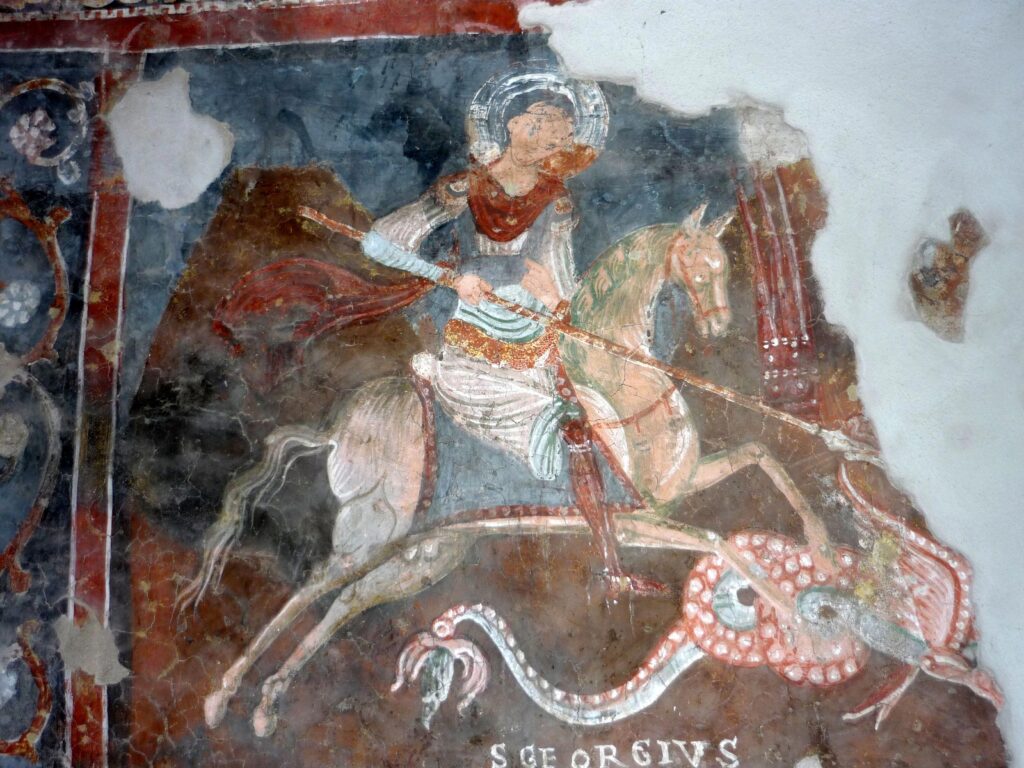
The Sanctuary preserves part of an 11th-century pictorial cycle that is truly one of a kind. Of this cycle, only the frescoes decorating the right wall of the central nave survive, and unfortunately, some of these remain fragmentary.
The decoration is organized into four registers, depicting the stories of Genesis, the stories of Joseph and Moses, and New Testament scenes, alongside representations of saints and their miracles.
Very little remains of the fourth register, but what is visible inspires awe due to the uniqueness of the subjects: a genre scene inside a pork butcher shop and another fragmentary scene featuring black demons with red wings. The style of these frescoes echoes the accounts of Saints Alexius and Clement in the lower church of San Clemente in Rome. The story is told with a fluid narrative, blending spatial awareness and syntactic structure that foreshadowed the great revolution soon to sweep through Western art.
Clear examples of this shift are found in several episodes, such as the one depicting Joseph and his brothers at the well. In this scene, all characters—including the Ishmaelites—participate in the drama, converging toward the center where the climax of the episode unfolds. The same can be said for the Sacrifice of Isaac, which is filled with a sense of pathos that had been absent from Western art for centuries. The figures express their exemplary nature through action, such as Saint Sylvester captured in the moment he defeats the dragon hidden within the Roman Forum.
The primary catalyst for this cultural revolution was Hildebrand of Sovana, who, in the second half of the 11th century, shook Europe with the Dictatus Papae—the manifesto of a renewed spiritual power, primary and inalienable before the earthly power of the Emperor. Painting became a weapon of papal policy, an effective tool to draw followers away from the imperial faction.
These frescoes, therefore, serve as exempla—useful tools to carry the Pope’s voice to those who were meant to embrace his absolutist program. The genre scene of the butcher immersed in his shop with his family is astonishing for its immediate language, revealing a desire to establish a direct dialogue with the faithful who stand “face-to-face” with the fresco. Similarly, the demons with angelic wings and coiled tails remain as a memento of divine punishment for those who would oppose the primacy of ecclesiastical power over secular rule.
The cycle must be placed within a specific context: Tuscia, the birthplace of Hildebrand of Sovana (later Pope Gregory VII). The presence of these frescoes is an act of solidarity from the local lords toward the Pope, sealing the union of the citizenry with the power of the Bishop of Rome.
I stood before these scenes with incredulous eyes; I believe I spent an hour talking to those characters and scrutinizing their actions. It is a marvelous document of medieval painting that is still far too little known, yet unique in its ability to discourse and exemplify just how fragile human nature truly is.
Visit it to believe it.