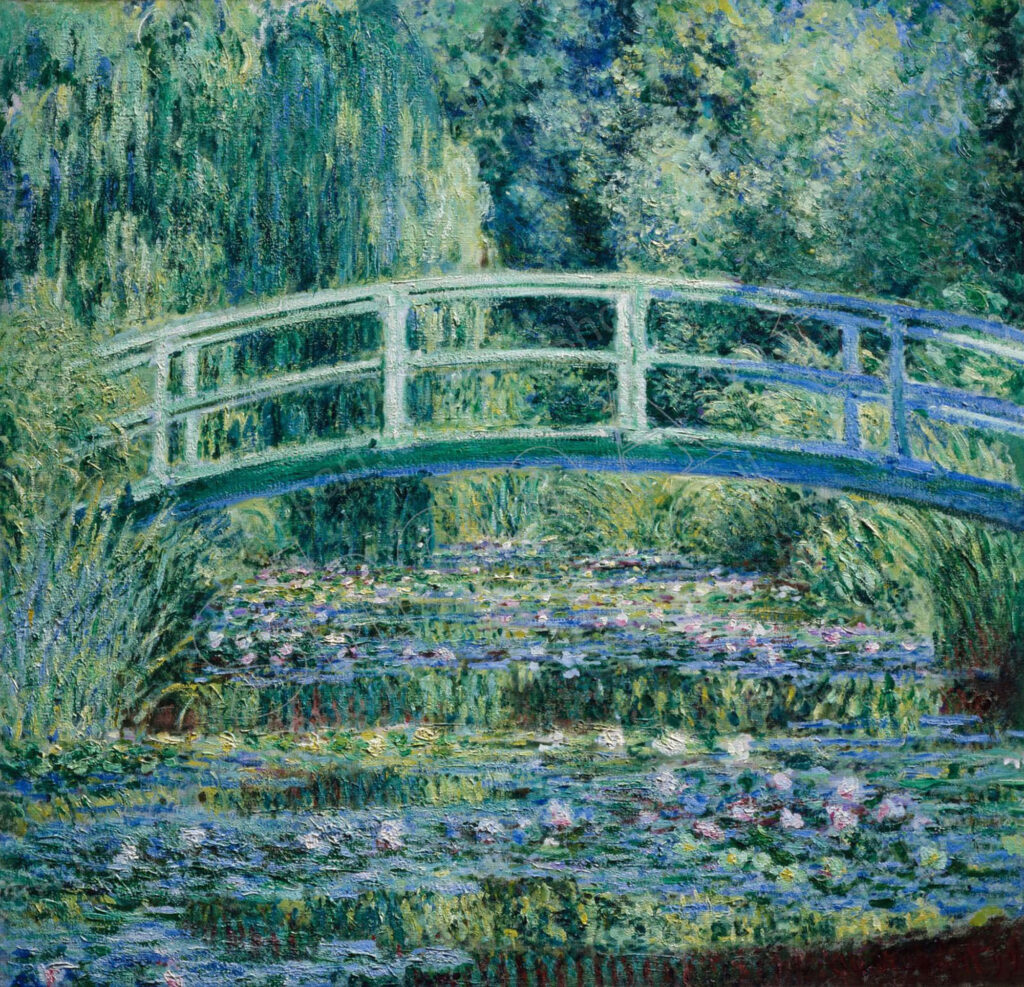
Claude Monet’s Water Lily Pond
“I follow nature without being able to grasp it; this river flows downward, rises again, one day green, then yellow, dry this afternoon and tomorrow a torrent.” — Claude Monet
Monet’s dream of becoming a gardener came true in 1893, when he settled in his house at Giverny. Water lilies, lotus flowers, irises, poppies, daffodils, verbenas, peonies, and bellflowers became the favored subjects of his paintings, captured in the changing seasons and partially immersed in the transparency of water.
The defining feature of the villa at Giverny was a pond where Monet cultivated what Marcel Proust described as “flowers blooming in the sky” — the water lilies. Delicate yet resilient, they seem to glide across the surface of the water, capturing and reflecting light in a kaleidoscope of colors. The garden thus became a harmonious symphony of light and water, shaped by the slow passage of time.
His obsession with painting water lilies grew so intense that toward the end of his life he wrote: “I no longer sleep because of them. At night I am constantly obsessed with what I am trying to achieve. I wake up exhausted […] painting is so difficult and tormenting. Last autumn I burned six canvases together with the dead leaves in the garden. There is enough to despair over. But I would not want to die before having said all that I had to say; or at least before having tried. And my days are numbered.”
A profound sense of incompleteness accompanied the painter until his death. In his attempt to halt the flow of time, Monet lived with the desire to capture an impression, always waiting for “tomorrow” — the day when he would finally succeed in painting his most beautiful work.